We’re reader-supported. This means when you buy through links on our site, we may earn an affiliate commission.
Building muscle does not require a fancy gym membership, rows of heavy barbells, or expensive equipment. Millions of people around the world are discovering that the best home workout for muscle gain can be just as effective as any commercial gym routine, provided it is structured correctly and executed with consistency.
Whether someone is brand new to fitness or a seasoned lifter looking to train at home, understanding the principles behind muscle growth is the first step to building a physique that turns heads.
Understanding Muscle Gain: The Science Made Simple
Before diving into workouts, it helps to understand what actually causes muscles to grow. Muscle hypertrophy, the scientific term for muscle growth, occurs when muscle fibers experience stress, sustain microscopic damage, and then repair themselves thicker and stronger than before. This process is driven by three core mechanisms:
- Mechanical tension created by lifting or pushing against resistance
- Metabolic stress caused by the buildup of metabolic byproducts during high-rep training
- Muscle damage from eccentric (lengthening) contractions that trigger repair and growth
At home, all three of these mechanisms can be stimulated through bodyweight exercises, resistance bands, dumbbells, or even improvised tools like filled backpacks and water jugs. The key is progressive overload, which means continuously increasing the challenge placed on the muscles over time.
Can You Really Build Muscle at Home?
This is one of the most common questions people have when they start searching for the best home workout for muscle gain. The answer is a confident yes. Research consistently shows that bodyweight and resistance-based training at home can produce significant muscle growth, especially when training volume, intensity, and rest periods are well managed.
The caveat is that training at home requires more creativity and discipline than walking into a gym full of machines. Progress may look different. Instead of adding weight plates to a bar, a person progresses by mastering harder exercise variations, adding more reps, reducing rest time, or adding resistance through bands or weighted vests. The body does not know the difference between a barbell and a set of resistance bands as long as the stimulus is sufficient.
Essential Principles for a Muscle-Building Home Workout
Any effective muscle-building program, whether done at home or in a gym, must follow certain principles. These form the backbone of all successful training plans.
Progressive Overload
As mentioned earlier, muscles must be continuously challenged to grow. At home, this means finding ways to make exercises harder week over week. Some practical methods include:
- Increasing repetitions per set
- Adding pauses or slow tempos to exercises
- Progressing to harder exercise variations (for example, moving from knee push-ups to full push-ups to archer push-ups)
- Adding resistance bands or weighted vests
- Reducing rest periods between sets
Training Volume and Frequency
Research supports training each muscle group roughly two to three times per week for optimal growth. A full-body workout approach three times per week works particularly well for home trainers, though upper/lower or push/pull splits are also effective.
Adequate Rest and Recovery
Muscles grow during rest, not during the workout itself. Sleeping seven to nine hours per night and allowing at least 48 hours between training the same muscle group gives the body time to repair and build new muscle tissue.
Nutrition
No workout plan builds muscle without proper nutrition. A diet rich in protein (aiming for around 0.7 to 1 gram per pound of bodyweight), complex carbohydrates, and healthy fats provides the raw materials muscles need to grow and recover.
The Best Home Workout for Muscle Gain: A Full-Body Program
The following program is designed for three days per week with at least one rest day between sessions. It targets all major muscle groups using minimal equipment: a set of resistance bands, a pair of adjustable dumbbells (optional), and a sturdy chair or table.
Day 1: Push and Core Focus
Warm-Up (5 minutes)
- Arm circles, shoulder rolls, hip circles, and light jumping jacks
Main Workout
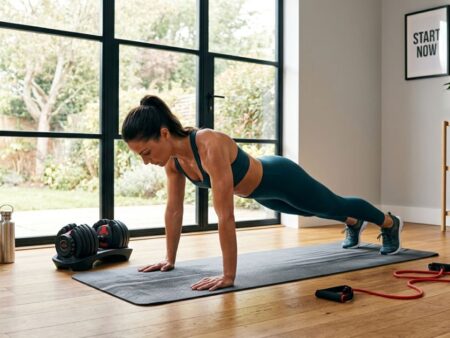
- Push-Ups (3 sets of 10 to 20 reps): The foundation of any home chest and tricep workout. Hands should be slightly wider than shoulder-width. To increase difficulty, elevate the feet or try diamond push-ups.
- Pike Push-Ups (3 sets of 10 to 15 reps): A bodyweight shoulder press alternative. Form an inverted V shape with the hips high and lower the head toward the floor.
- Tricep Dips Using a Chair (3 sets of 12 to 15 reps): Targets the back of the arms effectively. Keep the back close to the chair and lower until the elbows reach 90 degrees.
- Plank (3 sets of 30 to 60 seconds): Builds core stability, which supports all other movements.
- Mountain Climbers (3 sets of 20 reps per leg): Combines core activation with cardiovascular conditioning.
Day 2: Pull and Bicep Focus
Warm-Up (5 minutes)
- Cat-cow stretches, band pull-aparts, and light jogging in place
Main Workout
- Resistance Band Rows (3 sets of 12 to 15 reps): Anchor a band around a doorknob, hold both ends, and row the elbows back. This mimics a seated cable row.
- Band Bicep Curls (3 sets of 12 to 15 reps): Stand on the center of the band and curl both handles upward, squeezing at the top.
- Superman Hold (3 sets of 10 to 12 reps): Lie face down and lift both arms and legs simultaneously to work the lower back and glutes.
- Inverted Rows Under a Table (3 sets of 8 to 12 reps): Slide under a sturdy table, grip the edge, and pull the chest up to it. One of the best home exercises for back thickness.
- Reverse Snow Angels (3 sets of 12 reps): Lie face down and move the arms from the sides up overhead, keeping them off the floor throughout.
Day 3: Legs and Glutes Focus
Warm-Up (5 minutes)
- Leg swings, hip circles, and bodyweight squats
Main Workout
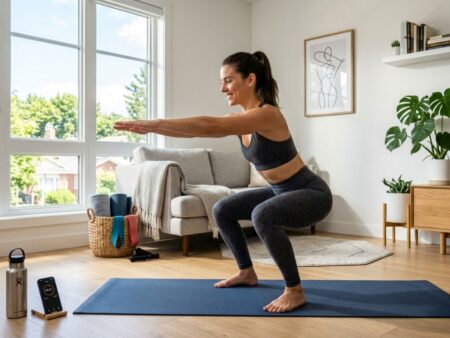
- Bodyweight Squats (3 sets of 15 to 20 reps): Work the quads, hamstrings, and glutes. Progress to jump squats or single-leg squats for greater challenge.
- Romanian Deadlifts with Dumbbells or Bands (3 sets of 10 to 12 reps): Hinge at the hips and lower the weight along the legs, feeling a deep hamstring stretch.
- Bulgarian Split Squats (3 sets of 10 reps per leg): Elevate the rear foot on a chair and lower the front knee toward the floor. One of the most effective unilateral leg exercises available.
- Glute Bridges (3 sets of 15 to 20 reps): Lying on the back with knees bent, drive the hips toward the ceiling and hold at the top. Add a resistance band above the knees for extra activation.
- Calf Raises (3 sets of 20 reps): Stand on the edge of a step and rise onto the toes, then lower slowly for a full stretch.
Exercise Progression Guide
One of the biggest challenges for home trainers is knowing when and how to progress. The table below outlines a practical progression path for the most commonly used exercises.
| Exercise | Beginner Version | Intermediate Version | Advanced Version |
|---|---|---|---|
| Push-Ups | Knee Push-Ups | Full Push-Ups | Archer Push-Ups / Decline Push-Ups |
| Squats | Assisted Squats (holding a wall) | Bodyweight Squats | Jump Squats / Pistol Squat Progressions |
| Rows | Band Rows (light resistance) | Inverted Rows | Single-Arm Inverted Rows |
| Lunges | Reverse Lunges | Walking Lunges | Bulgarian Split Squats |
| Pike Push-Ups | Elevated Pike Push-Ups | Pike Push-Ups | Handstand Push-Up Progressions |
| Hip Hinges | Glute Bridges | Romanian Deadlifts (bands) | Single-Leg Romanian Deadlifts |
The Role of Resistance Bands in Home Muscle Building
Resistance bands are arguably the most valuable piece of equipment a home gym can have. They are inexpensive, portable, and versatile enough to add resistance to almost any exercise. More importantly, bands provide variable resistance, meaning they get harder as they stretch, which places maximum tension on muscles at the top of a movement where free weights often become easier.
For building muscle at home, a set of three to five bands with varying resistance levels (light, medium, and heavy) opens up a world of exercise options. Rows, chest presses, shoulder presses, bicep curls, tricep pushdowns, and lateral band walks can all be performed with bands, covering every major muscle group effectively.
Nutrition Tips to Maximize Home Workout Results
Training hard is only half of the muscle-building equation. Without proper fueling, the body will struggle to recover and grow, no matter how good the workout is.
- Prioritize protein at every meal: Chicken, fish, eggs, Greek yogurt, legumes, and cottage cheese are all excellent sources.
- Eat enough calories: A slight caloric surplus of 200 to 300 calories above maintenance supports muscle gain without excessive fat storage.
- Time nutrition around workouts: Eating a protein-rich meal within one to two hours before and after training helps support muscle protein synthesis.
- Stay hydrated: Even mild dehydration can impair strength and performance. Aim for at least two to three liters of water daily.
- Do not skip carbohydrates: Carbs are the body’s preferred fuel source during intense exercise. Oats, rice, sweet potatoes, and fruits are great options.
Common Mistakes to Avoid in Home Muscle Building
Even the most dedicated home gym enthusiasts can fall into habits that slow their progress. Being aware of these pitfalls makes it easier to stay on track.
- Training without a plan: Random workouts rarely lead to consistent muscle gain. Following a structured program with clear goals is far more effective.
- Ignoring recovery: More is not always better. Overtraining leads to fatigue, injury, and stalled progress. Rest days are not optional.
- Skipping the warm-up: Cold muscles are more prone to injury. A proper warm-up increases blood flow and prepares joints for the work ahead.
- Neglecting the upper back: Push movements are easy to overdo at home. Balancing them with sufficient pulling exercises prevents posture problems and shoulder injuries.
- Not tracking progress: Without tracking reps, sets, and exercise variations, it is impossible to know whether progress is being made. A simple notebook or fitness app does the job.
How Long Before Results Are Visible?
Patience is a virtue in muscle building. Most beginners begin to notice strength improvements within the first two to four weeks of consistent training, as the nervous system adapts and motor patterns improve. Visible muscle changes typically begin to appear between six and twelve weeks, depending on training consistency, nutrition, sleep, genetics, and starting fitness level.
Staying consistent for at least three months before making major program changes gives the body enough time to respond and adapt. Taking progress photos every two to four weeks is a great motivational tool, since changes in muscle size can be subtle from day to day but striking when compared over several months.
Creating the Ideal Home Workout Environment
The environment in which someone trains has a measurable impact on their consistency and performance. A dedicated workout space, even a small one, removes friction and makes it easier to show up every day.
- Clear a designated area of at least six by six feet for floor exercises and movement
- Invest in a quality exercise mat to protect joints during floor work
- Keep equipment organized and visible as a visual cue to train
- Use music or motivational content to boost energy and focus during sessions
- Set a consistent workout time to build a lasting habit
Final Thoughts
The best home workout for muscle gain is the one that a person will actually do consistently, with progressive challenge and proper nutrition supporting every session. Bodyweight training, resistance bands, and a pair of dumbbells are genuinely all that is needed to build an impressive, functional physique from the comfort of home.
With the right program, the right mindset, and the right fueling strategy, home training is not a compromise. For many people, it is the most sustainable and empowering fitness choice they will ever make.
Disclaimer: The information provided on this website is for educational and informational purposes only and is not intended as medical advice. Always consult a qualified healthcare professional before starting any exercise program, changing your diet, or using supplements.