We’re reader-supported. This means when you buy through links on our site, we may earn an affiliate commission.
Building muscle, losing fat, or simply staying active no longer requires a gym membership. With the right plan, a small amount of space, and some consistency, anyone can build an effective home workout routine that delivers real results. Whether the goal is strength, fat loss, or general fitness, the key lies in structure, not fancy equipment.
This guide breaks down everything needed to build a home workout routine from scratch, including how to choose exercises, structure a weekly split, track progress, and stay motivated long term.
Why a Home Workout Routine Works
Many people assume that serious progress only happens inside a commercial gym. That simply is not true. The human body responds to consistent resistance, movement, and progressive overload, regardless of where that stimulus comes from. A well-designed home routine can build strength, improve endurance, and even pack on muscle just as effectively as a gym-based program.

Home workouts also offer some unique advantages:
- No commute time, which makes it easier to stay consistent
- Lower long-term cost compared to gym memberships
- Full control over the environment, music, and schedule
- Privacy for people who feel intimidated by crowded gyms
- Flexibility to train at any hour of the day
The tradeoff is that home training demands more planning. Without a coach or a room full of equipment, structure becomes even more important.
Step 1: Define the Goal First
Before choosing a single exercise, it helps to get clear on the main goal. Training for muscle growth looks different from training for fat loss or general health. Trying to chase every goal at once usually leads to a routine that does none of them well.
Common Home Training Goals
- Building muscle and strength
- Losing body fat while preserving muscle
- Improving cardiovascular endurance
- General health, mobility, and staying active
- Preparing for a specific sport or activity
Once the primary goal is set, everything else, including exercise selection, rep ranges, and rest periods, can be built around it.
Step 2: Take Inventory of Space and Equipment
A home workout routine should be designed around what is actually available, not an idealized gym setup. Some people have a spare room with a rack and barbell, while others have nothing more than floor space and a yoga mat.
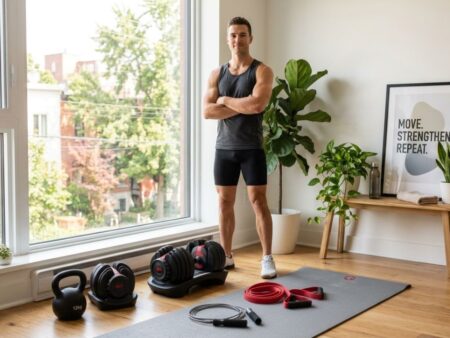
Minimal Equipment Setup
- Bodyweight only: floor space, maybe a pull-up bar
- Resistance bands for added tension
- A pair of adjustable dumbbells
- A yoga mat for floor-based work
Intermediate Home Gym Setup
- Adjustable dumbbells or a full dumbbell rack
- A bench, either flat or adjustable
- Resistance bands and a pull-up bar
- A kettlebell or two for dynamic movement
Advanced Home Gym Setup
- A power rack or squat stand
- An Olympic barbell and weight plates
- A bench press station
- Cable attachments or a functional trainer
There is no wrong starting point. Many successful physiques have been built using nothing more than bodyweight movements and a pair of dumbbells. The equipment matters less than the consistency behind using it.
Step 3: Choose a Weekly Training Split
Once the goal and available equipment are clear, the next step is choosing how many days per week to train and how those days will be organized. This is often called a training split.
Popular Home Workout Splits
| Split Type | Days Per Week | Best For |
|---|---|---|
| Full Body | 3 days | Beginners, limited equipment, general fitness |
| Upper/Lower | 4 days | Intermediate lifters wanting more volume |
| Push/Pull/Legs | 3 to 6 days | Muscle building with more exercise variety |
| Bodyweight Circuit | 3 to 5 days | Fat loss, no equipment, conditioning focus |
Beginners generally do best with a full body split performed three times per week, since it allows each muscle group to be trained frequently without overwhelming a body that is still adapting to regular exercise. More experienced trainees may prefer an upper/lower or push/pull/legs split to add training volume and variety.
Sample Weekly Layout
- Monday: Full body strength
- Tuesday: Rest or light cardio
- Wednesday: Full body strength
- Thursday: Rest or mobility work
- Friday: Full body strength
- Saturday: Optional cardio or active recovery
- Sunday: Rest
This layout can be adjusted based on schedule, recovery ability, and how quickly progress is being made.
Step 4: Select the Right Exercises
Every home workout routine should be built around foundational movement patterns. These patterns cover the major muscle groups and can be adapted to almost any equipment level.
Core Movement Patterns to Include
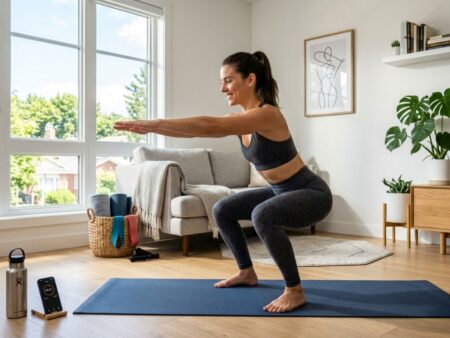
- Squat pattern: bodyweight squats, goblet squats, split squats
- Hinge pattern: glute bridges, Romanian deadlifts, kettlebell swings
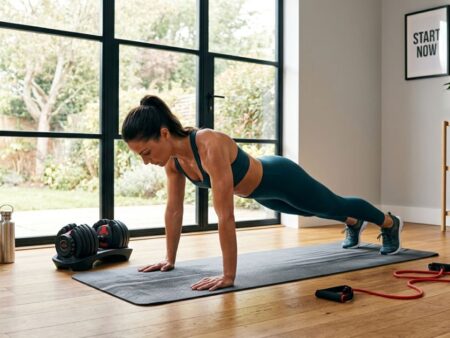
- Push pattern: push-ups, dumbbell presses, pike push-ups
- Pull pattern: rows, pull-ups, resistance band pulls
- Core and stability: planks, dead bugs, side planks
Sample Full Body Home Workout
- Squats or goblet squats: 3 sets of 10 to 15 reps
- Push-ups or dumbbell bench press: 3 sets of 8 to 12 reps
- Bent-over rows or resistance band rows: 3 sets of 10 to 12 reps
- Romanian deadlifts or glute bridges: 3 sets of 12 to 15 reps
- Plank: 3 sets, holding for 30 to 45 seconds
This type of session hits every major muscle group and can be completed in around 45 minutes, making it realistic for busy schedules.
Step 5: Apply Progressive Overload
Progressive overload is the single most important principle in any workout routine, home based or otherwise. Without it, the body has no reason to adapt or grow stronger. This simply means gradually increasing the challenge over time.
Ways to Apply Progressive Overload at Home
- Adding more reps to each set week by week
- Increasing the weight of dumbbells or resistance bands
- Slowing down the tempo of each rep for more time under tension
- Reducing rest time between sets to increase intensity
- Adding an extra set once the current volume feels manageable
Without any weights at all, progressive overload can still happen. Moving from regular push-ups to decline push-ups, or from bodyweight squats to single-leg squats, increases difficulty without needing extra equipment.
Step 6: Warm Up and Cool Down Properly
Warming up before training reduces injury risk and prepares the muscles and joints for the work ahead. A short warm-up routine before every session pays off over time.
Simple Home Warm-Up Routine
- Five minutes of light movement such as marching in place or jumping jacks
- Arm circles and shoulder rolls to loosen the upper body
- Bodyweight squats and hip circles to open the lower body
- A few light warm-up sets of the first exercise before adding weight
Cool Down Basics
- A few minutes of walking or light movement to bring the heart rate down
- Static stretching for the major muscle groups trained that day
- Deep breathing to help the nervous system shift out of training mode
Step 7: Track Progress Consistently
One of the biggest mistakes people make with home workouts is failing to track anything. Without a record of reps, sets, and weights used, it becomes difficult to know whether real progress is happening.
Simple Ways to Track a Home Routine
- Keep a notebook or spreadsheet logging exercises, sets, reps, and weight
- Take progress photos every few weeks under consistent lighting
- Track body measurements such as waist, arms, and thighs
- Note how workouts feel, including energy levels and recovery
Tracking does not need to be complicated. Even a basic phone notes app is enough to spot patterns and confirm that the program is working.
Step 8: Build in Recovery and Rest Days
Muscles do not grow during the workout itself. They grow during the recovery period afterward, when the body repairs and rebuilds tissue that was broken down during training. Skipping rest days is one of the fastest ways to stall progress or increase the risk of injury.
Recovery Priorities
- Aim for seven to nine hours of sleep per night
- Include at least one to two full rest days per week
- Eat enough protein to support muscle repair
- Stay hydrated, especially on training days
- Consider light activity like walking on rest days instead of complete inactivity
Common Mistakes to Avoid
Even well-intentioned home workout routines can go wrong. Being aware of common pitfalls makes it easier to avoid them.
- Training without any real plan or structure
- Doing the same workout every single day without variation
- Ignoring lower body training in favor of only upper body exercises
- Ramping up intensity too quickly without a proper warm-up
- Skipping recovery days out of fear of losing progress
- Comparing home training results to gym-based influencers with access to far more equipment
Staying Consistent Long Term
The best home workout routine is the one that actually gets done week after week. Motivation naturally rises and falls, so building habits and systems matters more than relying on willpower alone.
Tips for Long-Term Consistency
- Schedule workouts like any other appointment
- Prepare a workout space in advance so there is no friction to starting
- Set small, achievable goals rather than only long-term ones
- Change up exercises every four to six weeks to prevent boredom
- Celebrate small wins like an extra rep or a slightly heavier dumbbell
Final Thoughts
Building a home workout routine does not require a room full of expensive machines or hours of free time. What it requires is a clear goal, a simple but structured plan, consistent effort, and a willingness to progress gradually over time.
By choosing the right split, focusing on foundational movement patterns, applying progressive overload, and prioritizing recovery, anyone can build real strength and fitness from the comfort of home.
Consistency beats perfection. A simple routine followed consistently for months will always outperform a complicated program that gets abandoned after two weeks.
Disclaimer: The information provided on this website is for educational and informational purposes only and is not intended as medical advice. Always consult a qualified healthcare professional before starting any exercise program, changing your diet, or using supplements.