We’re reader-supported. This means when you buy through links on our site, we may earn an affiliate commission.
If there is one question that echoes through every gym floor, fitness forum, and bodybuilding community, it is this: how many sets and reps does it actually take to build the most muscle?
Whether someone is just starting out with a pair of dumbbells at home or has been training under the bar for years, the answer to this question can mean the difference between spinning their wheels and making serious, consistent gains.
The science of hypertrophy — the technical term for muscle growth — has come a long way over the past two decades. Researchers, coaches, and elite athletes have all contributed to a clearer understanding of what works, what is overrated, and what is an outright myth. This article breaks it all down in plain language so that anyone can apply it to their training immediately.
Understanding the Basics: What Are Sets and Reps?
Before diving into the numbers, it helps to make sure everyone is on the same page.
A rep (repetition) is a single complete movement of an exercise — one squat, one bicep curl, one bench press. A set is a group of consecutive reps performed without resting. So when a program says “3 sets of 10 reps,” it means performing an exercise 10 times, resting, and then doing that again two more times.
Volume — the total amount of work done, typically calculated as sets × reps × weight — is one of the most critical drivers of muscle growth. However, volume alone does not tell the whole story. Intensity, frequency, rest periods, and proximity to failure all play important roles as well.
The Science Behind Muscle Growth
Muscles grow in response to mechanical tension, metabolic stress, and muscle damage. When someone lifts weights, tiny micro-tears form in the muscle fibers. The body repairs these tears and, in doing so, builds the fibers back slightly thicker and stronger than before. This is the fundamental process of hypertrophy.
For this process to keep happening over time, the body needs to be progressively challenged — a principle known as progressive overload. Simply going through the motions with the same weight, sets, and reps week after week will not produce ongoing results. Muscle growth demands that the stimulus continue to increase.
How Many Reps Should You Do to Build Muscle?
For a long time, the classic “hypertrophy range” was considered to be 8–12 reps per set. This recommendation came from decades of bodybuilding practice and was later supported by early research. The idea was that heavier weights with lower reps built strength, and lighter weights with higher reps built endurance, leaving the middle ground as the sweet spot for size.
More recent research has shifted this view considerably. A landmark series of studies found that muscle can be built effectively across a wide rep range, from as low as 5 reps per set to as high as 30 reps per set — as long as sets are taken close to muscular failure.
The key takeaway: the rep range matters less than most people think. What matters most is the effort level. A set of 5 reps at near-maximum weight and a set of 25 reps with a lighter load can produce similar hypertrophic results if both are pushed to or near failure.
That said, most coaches and evidence-based practitioners still recommend spending the majority of training time in the 6–20 rep range, as this tends to offer a practical balance of mechanical tension, metabolic stress, manageable fatigue, and joint comfort.
Rep Range Quick Reference
| Rep Range | Primary Benefit | Best Use Case |
|---|---|---|
| 1–5 reps | Maximal strength | Powerlifting, strength base building |
| 6–12 reps | Strength + Hypertrophy | Core muscle-building work |
| 13–20 reps | Hypertrophy + Endurance | Accessory work, joint-friendly training |
| 20–30 reps | Metabolic stress, endurance | Drop sets, pump work, rehabilitation |
How Many Sets Per Exercise Should You Do?
This is where training volume gets a bit more nuanced. The current research suggests that more weekly sets per muscle group generally leads to more muscle growth — but only up to a point. Beyond that point, additional volume starts producing diminishing returns or, worse, overtraining and regression.
Minimum Effective Volume
For muscle growth to occur, research suggests a minimum of around 10 working sets per muscle group per week. This is sometimes referred to as the minimum effective volume (MEV). Anything below this threshold may maintain muscle or produce modest gains in beginners, but it is unlikely to drive significant growth in most intermediate or advanced trainees.
Optimal Volume Range
The sweet spot for most people appears to be between 10 and 20 sets per muscle group per week. Within this range, most individuals will experience consistent hypertrophy without accumulating excessive fatigue.
Maximum Adaptive Volume
Beyond 20 sets per muscle group per week, some advanced athletes can continue to grow, but this territory requires careful recovery management, high-quality nutrition, and often — in the case of professional bodybuilders — pharmaceutical support. For natural lifters, pushing much beyond 20 sets per muscle group per week often leads to overreaching.
How Many Sets Per Session?
Rather than cramming all weekly volume into a single session, it is more productive — and supported by research — to spread volume across multiple sessions per week. Training a muscle group 2–3 times per week with moderate per-session volume consistently outperforms training it once a week with very high volume.
A practical breakdown might look like this:
- Beginner (0–1 year training): 10–12 sets per muscle group per week, split across 2 sessions
- Intermediate (1–3 years training): 12–16 sets per muscle group per week, split across 2–3 sessions
- Advanced (3+ years training): 16–22 sets per muscle group per week, split across 3+ sessions
The Role of Proximity to Failure
One of the most important concepts in modern hypertrophy training is Reps in Reserve (RIR) — meaning how many more reps could theoretically be completed before hitting absolute muscular failure.
Research shows that sets need to be taken relatively close to failure to maximally stimulate muscle growth. Specifically:
- 0–3 RIR (stopping 0 to 3 reps before failure) consistently produces strong hypertrophic responses
- 4+ RIR produces significantly less muscle-building stimulus, even if the volume on paper looks the same
- Training to absolute failure can be effective but increases fatigue and injury risk disproportionately
For most people, aiming to end sets at around 1–2 RIR offers an excellent balance of stimulus and sustainability. This means the last rep should feel genuinely hard, but the form should still be clean and controlled.
How Long Should You Rest Between Sets?
Rest periods are often underestimated in their impact on muscle growth. Two schools of thought have historically clashed here: shorter rest periods (60–90 seconds) to maximize metabolic stress and the “pump,” versus longer rest periods (2–5 minutes) to allow fuller recovery and maintain performance across sets.
Modern research leans toward longer rest periods of 2–3 minutes for compound exercises (squats, deadlifts, bench press, rows) and 1–2 minutes for isolation exercises (curls, lateral raises, cable flyes). Longer rests allow more weight to be moved across all sets, which means more total mechanical tension — a primary driver of growth.
Short rest periods are not without value, particularly for metabolic conditioning and time efficiency, but they should not be the default approach for those whose primary goal is maximum muscle hypertrophy.
Sample Weekly Set and Rep Schemes
Beginner Full-Body Program (3 Days/Week)
- Compound lifts (squat, press, row, hinge): 3 sets × 8–10 reps, 2–3 RIR
- Isolation work (curls, tricep work, lateral raises): 2–3 sets × 10–15 reps
- Rest between sets: 2 minutes for compounds, 90 seconds for isolation
- Total weekly sets per muscle group: approximately 10–12
Intermediate Upper/Lower Split (4 Days/Week)
- Upper day compounds: 3–4 sets × 6–10 reps
- Upper day isolation: 3 sets × 10–15 reps
- Lower day compounds: 3–4 sets × 6–10 reps
- Lower day accessories: 3 sets × 10–20 reps
- Total weekly sets per muscle group: approximately 12–16
Advanced Push/Pull/Legs Split (6 Days/Week)
- Primary compound movements: 4 sets × 5–8 reps
- Secondary compound movements: 3–4 sets × 8–12 reps
- Isolation and pump work: 3 sets × 12–20 reps
- Total weekly sets per muscle group: approximately 16–22
Common Mistakes That Limit Muscle Growth
Even with the right set and rep targets in mind, certain habits can sabotage progress. Here are the most common pitfalls to avoid:
- Stopping sets too early: Leaving 5 or more reps in reserve consistently means the muscle is not being stimulated hard enough to grow
- Doing too much too soon: Jumping to 25+ sets per muscle group per week without building up gradually leads to joint issues and chronic fatigue
- Ignoring progression: Doing the same weights, reps, and sets week after week halts growth; the program must progressively overload over time
- Neglecting compound movements: Isolation exercises have their place, but multi-joint lifts like squats, deadlifts, and rows drive the most overall muscle development
- Undervaluing rest and recovery: Muscle is not built during the workout — it is built during sleep and rest; skimping on recovery undermines all the work put in under the bar
- Inconsistent training frequency: Sporadic training does not allow the body to adapt; consistency over months and years is what produces transformative results
Adapting Sets and Reps for Home Training
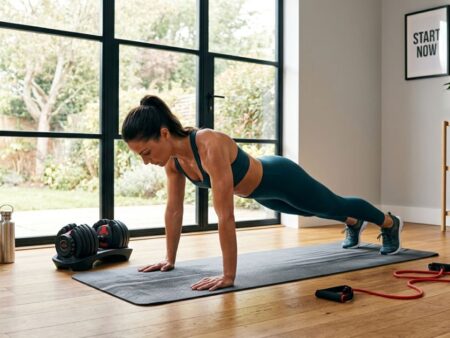
Not everyone has access to a commercial gym, and that is perfectly fine. The principles of sets, reps, and proximity to failure apply equally whether someone is training at home with resistance bands and bodyweight or in a fully equipped facility.
For home trainers:
- Bodyweight exercises like push-ups, dips, and Bulgarian split squats can be made more challenging by slowing down the tempo, adding pauses, or using a weighted backpack
- Resistance bands provide variable resistance and can effectively target muscles through a full range of motion
- Adjustable dumbbells are one of the most versatile investments for home gym training
- The same weekly volume targets apply — aim for 10–20 sets per muscle group per week, spread across multiple sessions
The most important thing is that sets are taken hard enough. A set of 20 bodyweight squats that ends with 5 reps still in the tank is far less productive than a set of 15 that reaches the point of genuine struggle.
Putting It All Together
The answer to how many sets and reps build the most muscle is not a single magic number — it is a framework. For the vast majority of people, the following guidelines provide an excellent foundation:
- Rep range: 6–20 reps per set, with the majority of work in the 8–15 range
- Weekly sets per muscle group: 10–20, increasing gradually over time
- Proximity to failure: End most sets at 1–3 RIR
- Rest periods: 2–3 minutes for compounds, 90 seconds to 2 minutes for isolation work
- Frequency: Train each muscle group 2–3 times per week
- Progressive overload: Consistently aim to do a little more over time — more reps, more weight, or more sets
Muscle building is not complicated, but it does require consistency, honesty about effort levels, and patience. The lifters who look the most impressive are not usually those who followed the most exotic program — they are the ones who applied sensible, evidence-based principles and showed up, week after week, for years.
Disclaimer: The information provided on this website is for educational and informational purposes only and is not intended as medical advice. Always consult a qualified healthcare professional before starting any exercise program, changing your diet, or using supplements.