We’re reader-supported. This means when you buy through links on our site, we may earn an affiliate commission.
Building muscle has long been associated with clanging iron in a packed gym, surrounded by racks of dumbbells and rows of barbells. But what happens when the gym isn’t an option — or simply isn’t preferred?
The question on many fitness enthusiasts’ minds is this: can you actually build muscle at home without equipment? The short answer is yes. The longer answer is a deep dive into the science, strategy, and methods that make it possible.
The Science Behind Muscle Growth
Before diving into home-based workouts, it helps to understand what actually causes muscles to grow. Muscle hypertrophy — the technical term for muscle growth — occurs when muscle fibers are subjected to mechanical tension, metabolic stress, and muscle damage. These three stimuli trigger the body to repair and rebuild muscle tissue larger and stronger than before.

The common misconception is that heavy barbells and machines are the only tools capable of producing these stimuli. In reality, the body doesn’t know the difference between a loaded barbell and a challenging bodyweight movement — it only responds to tension and effort. When a muscle is pushed close to its limit, regardless of the resistance source, adaptation occurs.
Progressive Overload: The Key Principle
The most important concept in any muscle-building program — whether in a gym or at home — is progressive overload. This means continually increasing the demand placed on the muscles over time. Without progression, the body has no reason to adapt and grow.
In a gym setting, progressive overload is straightforward: add more weight to the bar. At home without equipment, it requires a bit more creativity:
- Increasing the number of repetitions per set
- Reducing rest time between sets to increase density
- Slowing down the tempo of each rep (especially the lowering phase)
- Progressing to harder exercise variations (e.g., moving from regular push-ups to archer push-ups)
- Adding pauses at the most challenging point of a movement
- Increasing training volume over weeks and months
These methods are just as effective at creating the overload stimulus the muscles need to grow.
Why Bodyweight Training Works for Muscle Building
There is a growing body of evidence — and a long history of elite athletes — supporting the effectiveness of bodyweight training for building significant muscle mass. Gymnasts, for example, develop extraordinary upper body and core musculature using nothing but their bodyweight. Military personnel around the world build combat-ready physiques with calisthenics alone.
The reason bodyweight training works comes down to one simple truth: if an exercise is hard enough, the muscles will respond. A well-programmed bodyweight routine can challenge even experienced lifters and produce visible, lasting gains.
Advantages of Training at Home Without Equipment
Training without equipment at home comes with several benefits that gym-goers often overlook:
- No commute time — workouts can happen anywhere, anytime
- Zero cost — no gym membership, no equipment purchases
- Full privacy — ideal for beginners who feel self-conscious
- Flexibility — workouts can be done in a bedroom, backyard, or hotel room
- Consistency — removing barriers to training leads to more regular sessions
- Functional strength — bodyweight movements often build real-world mobility and coordination
The Best Bodyweight Exercises for Building Muscle
The foundation of any effective home muscle-building program is a selection of high-quality movements that target all major muscle groups. Here’s a breakdown of the best options by body part:
Upper Body
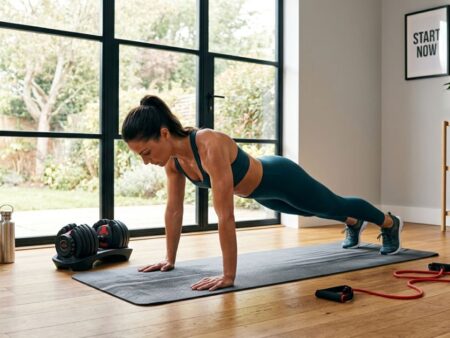
- Push-Up Variations — standard, wide-grip, close-grip, decline, incline, archer, and pseudo planche push-ups target the chest, triceps, and front deltoids with varying emphasis
- Dips — using two sturdy chairs, dips are one of the most effective exercises for the chest and triceps
- Pike Push-Ups — a shoulder-dominant variation that mimics the overhead press
- Inverted Rows — using a table edge or low bar, this movement builds the upper back and biceps similarly to a rowing machine
Core and Abs
- Plank Variations — standard plank, side plank, plank with shoulder taps, and RKC plank for deep core engagement
- Hollow Body Hold — a gymnastics staple that builds tremendous core tension and control
- Leg Raises — lying or hanging, targeting the lower abs and hip flexors
- Dead Bug — an underrated anti-rotation core movement that improves stability
Lower Body
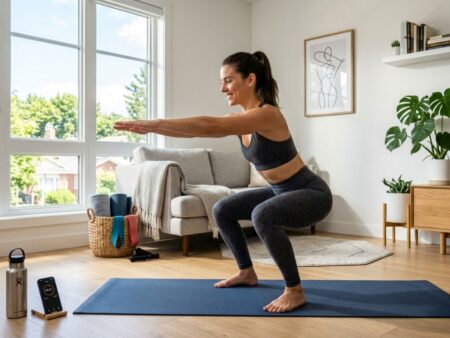
- Squat Variations — air squats, Bulgarian split squats, jump squats, and sissy squats for comprehensive quad and glute development
- Lunge Variations — walking lunges, reverse lunges, and lateral lunges for well-rounded leg training
- Glute Bridges and Hip Thrusts — isolating the glutes without any equipment
- Single-Leg Deadlifts — balance, posterior chain strength, and hamstring development all in one
- Calf Raises — simple but effective when performed with full range of motion and slow tempo
A Sample Weekly Muscle-Building Program (No Equipment)
A structured program is essential for consistent progress. The following is a sample split that can be performed entirely at home:
| Day | Focus | Key Exercises |
|---|---|---|
| Monday | Push (Chest, Shoulders, Triceps) | Push-up variations, pike push-ups, dips |
| Tuesday | Pull (Back, Biceps) | Inverted rows, doorframe rows, chin-ups if available |
| Wednesday | Legs and Glutes | Split squats, hip thrusts, single-leg deadlifts |
| Thursday | Rest or Active Recovery | Light stretching, walking, mobility work |
| Friday | Full Body Strength | Compound movements: push-ups, squats, lunges, planks |
| Saturday | Core and Conditioning | Ab circuit, hollow body, dead bugs, light cardio |
| Sunday | Rest | Full recovery |
This push-pull-legs structure ensures all major muscle groups are trained with adequate frequency and recovery time between sessions.
How to Progress Without Adding Weight
One of the most common frustrations people experience with home training is feeling like they’ve “maxed out” what bodyweight can offer. This is rarely the case. The key is understanding exercise progressions — structured progressions from easier to harder movements that continually challenge the body.
The Push-Up Progression Ladder
- Wall push-ups → Incline push-ups → Knee push-ups → Standard push-ups → Close-grip push-ups → Archer push-ups → One-arm assisted push-ups → Full one-arm push-ups
The Squat Progression Ladder
- Assisted squats (holding a door frame) → Air squats → Pause squats → Jump squats → Bulgarian split squats → Pistol squat progressions → Full pistol squats
By working through these progressions systematically, a person can continue building muscle for months or even years without ever touching a piece of equipment.
Nutrition: The Non-Negotiable Partner to Home Training
No conversation about building muscle is complete without addressing nutrition. Training provides the stimulus for muscle growth, but it is food — specifically protein — that provides the raw material for the muscles to actually rebuild.
Key Nutritional Guidelines for Muscle Building
- Eat enough protein — aim for roughly 1.6 to 2.2 grams of protein per kilogram of bodyweight daily
- Maintain a slight caloric surplus — consuming slightly more calories than burned supports muscle growth without excess fat gain
- Prioritize whole food sources — lean meats, eggs, legumes, dairy, fish, and plant-based proteins
- Stay hydrated — even mild dehydration impairs performance and recovery
- Time nutrition around workouts — a protein-rich meal before and after training maximises muscle protein synthesis
Even the most perfectly designed home workout program will underperform if nutrition is neglected. The two work in tandem, and both deserve equal attention.
Common Mistakes to Avoid
People new to home training often fall into patterns that limit their progress. Being aware of these pitfalls makes a significant difference:
- Treating bodyweight training as “easier” than gym training — it isn’t, and shouldn’t be approached that way
- Skipping the warm-up — joint mobility and muscle activation are just as important at home as in the gym
- Neglecting the posterior chain — push-dominant exercises are easier to do without equipment, so the back, glutes, and hamstrings often get undertrained
- Not tracking workouts — without records, it’s nearly impossible to ensure progressive overload is happening
- Inconsistency — the biggest limiter of any training program is showing up regularly; sporadic effort produces sporadic results
- Ignoring sleep — muscle is built during recovery, and sleep is the most powerful recovery tool available
How Long Before Results Are Visible?
Patience is an essential part of the muscle-building process, regardless of where the training happens. For most people following a consistent home program with proper nutrition:
- 2–4 weeks — improved muscle tone, better endurance, increased energy levels
- 6–12 weeks — noticeable changes in muscle definition and size, especially for beginners
- 6–12 months — significant transformation in physique and strength, with measurable muscle mass gains
Results will vary based on genetics, age, starting fitness level, training consistency, and nutrition. But for anyone wondering whether meaningful change is possible — the answer is an unequivocal yes.
Making the Most of Minimal Space
One of the great advantages of home training is that it requires very little space. A standard yoga mat-sized area (approximately 2 metres by 60 centimetres) is enough to perform the vast majority of bodyweight exercises. Even a small apartment bedroom provides enough room for a complete and effective workout.
For those who want to gradually add tools to their home setup without a major investment, a few low-cost additions can significantly expand exercise variety:
- Resistance bands — inexpensive and portable, adding accommodating resistance to bodyweight movements
- A pull-up bar — one of the single best investments for upper body development, fitting in most door frames for under $30
- Gymnastic rings — hanging from a door frame or ceiling beam, rings add instability and unlock dozens of advanced movements
None of these are necessary, but each one opens new avenues for progression.
The Mindset Shift That Changes Everything
Perhaps the most important factor in successfully building muscle at home without equipment isn’t a specific exercise or nutrition protocol — it’s the mindset. Many people unconsciously associate the gym with “real training” and home workouts with supplementary or lesser effort. Letting go of this bias is what separates those who achieve results from those who don’t.
The body responds to stimulus, not to a location. A well-executed pistol squat challenges the legs just as effectively as a loaded leg press. A slow, controlled set of archer push-ups taxes the chest no less than a dumbbell fly. When effort is genuine and programming is smart, the home becomes a perfectly capable training environment.
Building muscle at home without equipment is not a compromise — for many, it becomes the preferred way to train.
Disclaimer: The information provided on this website is for educational and informational purposes only and is not intended as medical advice. Always consult a qualified healthcare professional before starting any exercise program, changing your diet, or using supplements.