We’re reader-supported. This means when you buy through links on our site, we may earn an affiliate commission.
Starting a bodybuilding journey can feel overwhelming. Between confusing gym equipment, contradictory advice online, and the pressure to see results quickly, many beginners end up spinning their wheels without making real progress. The good news is that getting started with bodybuilding does not have to be complicated.
With the right routine, realistic expectations, and a solid understanding of the basics, anyone can begin building a stronger, more muscular physique — whether they train at a commercial gym or from the comfort of their own home.
This guide breaks down everything a beginner needs to know about structuring the best bodybuilding routine, including how to train, what to prioritize, how often to work out, and how to track progress effectively.
Why a Structured Routine Matters for Beginners
One of the biggest mistakes new lifters make is walking into the gym without a plan. Random training — doing whatever machine is available or copying whatever someone else is doing — rarely produces consistent results. A structured routine removes the guesswork and ensures that every muscle group receives adequate stimulation, recovery time, and progressive challenge over time.
Beginners are in a uniquely advantageous position known as “newbie gains.” During the first several months of training, the body responds rapidly to resistance training, building muscle and strength faster than at any other point in a lifter’s career. A well-designed beginner routine takes full advantage of this window.
Core Principles of a Beginner Bodybuilding Routine
Before diving into specific workouts, it helps to understand the foundational principles that make any bodybuilding program effective.
Progressive Overload
Progressive overload is the cornerstone of muscle building. It simply means that over time, the body must be challenged with gradually increasing resistance, volume, or difficulty. Without it, muscles have no reason to adapt or grow. Beginners should aim to add small amounts of weight to their lifts each week or every other week as strength improves.
Compound Movements First
Compound exercises — movements that engage multiple muscle groups simultaneously — should form the backbone of any beginner program. Exercises like the squat, deadlift, bench press, overhead press, and barbell or dumbbell row build overall mass, strength, and coordination far more efficiently than isolation exercises alone.
Adequate Recovery
Muscles do not grow during training — they grow during rest. Beginners often make the mistake of training too frequently without allowing enough time for recovery. Most experts recommend that each muscle group receive at least 48 hours of rest between sessions.
Consistency Over Intensity
A moderate, consistent routine performed week after week will always outperform an extreme program that burns someone out after two weeks. Showing up regularly and applying progressive overload is the most reliable path to results.
How Many Days a Week Should Beginners Train?
For most beginners, training 3 to 4 days per week strikes the ideal balance between stimulus and recovery. This frequency allows each muscle group to be trained multiple times per week while still leaving enough rest days for the body to repair and grow.
| Training Days Per Week | Best For | Example Split |
|---|---|---|
| 2 days | Very beginners or limited schedules | Full body x2 |
| 3 days | Most beginners | Full body or Push/Pull/Legs |
| 4 days | Intermediate beginners | Upper/Lower split |
| 5+ days | Not recommended for beginners | Risk of overtraining |
The Best Training Splits for Beginners
Full Body Training (3 Days Per Week)
Full body training is arguably the most effective approach for beginners. By training every major muscle group in each session, beginners maximize the frequency with which muscles are stimulated — which is crucial for growth in the early stages. A typical full body schedule looks like this:
- Monday: Full Body Workout A
- Wednesday: Full Body Workout B
- Friday: Full Body Workout A (alternating)
Each session includes one compound movement for the legs, one for the chest/push muscles, one for the back/pull muscles, and one or two accessory exercises for arms and shoulders.
Upper/Lower Split (4 Days Per Week)
Once a beginner has developed a baseline of strength and coordination — typically after 8 to 12 weeks — an upper/lower split can be a natural progression. This approach trains the upper body twice a week and the lower body twice a week, allowing for slightly more volume per session.
- Monday: Upper Body
- Tuesday: Lower Body
- Thursday: Upper Body
- Friday: Lower Body
Push/Pull/Legs (3 Days Per Week)
The Push/Pull/Legs split divides training by movement pattern rather than body part. Push days target the chest, shoulders, and triceps. Pull days focus on the back and biceps. Leg days cover the quads, hamstrings, glutes, and calves. This is a logical and popular split that works well for beginners who want to train each muscle group with focused intensity.
Sample Beginner Full Body Workout
Below is a simple, effective beginner full body routine that can be performed three times per week. Rest 60 to 90 seconds between sets for most exercises, and 2 to 3 minutes between heavy compound sets.
Workout A
- Barbell Back Squat — 3 sets x 8 reps
- Dumbbell Bench Press — 3 sets x 10 reps
- Barbell or Dumbbell Row — 3 sets x 10 reps
- Overhead Dumbbell Press — 3 sets x 10 reps
- Romanian Deadlift — 3 sets x 10 reps
- Plank — 3 sets x 30–45 seconds
Workout B
- Goblet Squat or Leg Press — 3 sets x 10 reps
- Incline Dumbbell Press — 3 sets x 10 reps
- Lat Pulldown or Assisted Pull-Up — 3 sets x 10 reps
- Lateral Raises — 3 sets x 12 reps
- Leg Curl — 3 sets x 12 reps
- Dumbbell Bicep Curl — 3 sets x 12 reps
These two workouts should be alternated across training days throughout the week.
Home Workout Option for Beginners
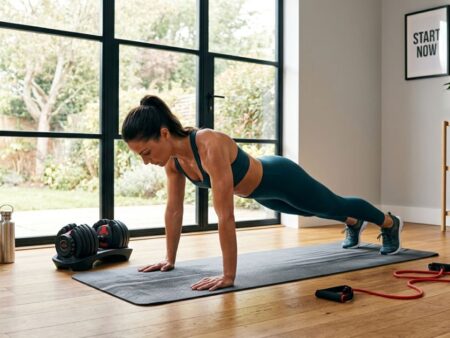
Not everyone has access to a gym, and the good news is that a beginner can build a respectable foundation of muscle and strength at home with minimal equipment. A set of adjustable dumbbells and a resistance band can cover the majority of movements needed in the early months of training.
Beginner Home Workout (3 Days Per Week)
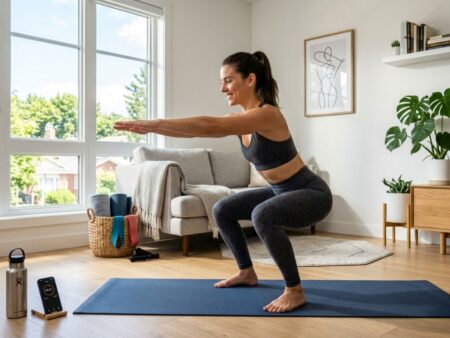
- Bodyweight Squat or Dumbbell Goblet Squat — 3 sets x 15 reps
- Push-Ups (standard or incline) — 3 sets x 10–15 reps
- Dumbbell Row (using a chair for support) — 3 sets x 10 reps per side
- Dumbbell Shoulder Press — 3 sets x 10 reps
- Glute Bridge or Single-Leg Deadlift — 3 sets x 12 reps
- Resistance Band Pull-Apart — 3 sets x 15 reps
As fitness improves, difficulty can be increased by slowing down the tempo, adding pauses, or increasing dumbbell weight.
Essential Tips for Beginner Bodybuilders
Learn Proper Form Before Adding Weight
Poor technique is the fastest route to injury and one of the most common mistakes beginners make. Before loading up a bar, new lifters should spend time learning the mechanics of foundational movements. Watching instructional videos, working with a trainer for even one or two sessions, or using lighter weights to practice form are all worthwhile investments.
Track Workouts in a Log
Keeping a training journal — even just a notes app on a smartphone — is one of the simplest habits that separates successful lifters from those who plateau early. Tracking weights, sets, and reps makes it easy to apply progressive overload and identify when it is time to increase the challenge.
Prioritize Sleep
Sleep is when the majority of muscle repair and growth hormone release occurs. Beginners who are serious about building muscle should aim for 7 to 9 hours of quality sleep each night. Without adequate rest, even the best training program will underperform.
Do Not Neglect Nutrition
No bodybuilding routine is complete without attention to diet. Muscles are built from protein, so ensuring adequate protein intake is critical. A general guideline for those focused on muscle building is consuming around 0.7 to 1 gram of protein per pound of bodyweight per day. Caloric intake should also support the goal — a slight caloric surplus supports muscle gain, while maintenance or a small deficit is appropriate for those looking to build muscle while managing body fat.
Be Patient and Trust the Process
Results in bodybuilding take time. Most beginners will begin to notice visible changes within 8 to 12 weeks of consistent training, but significant transformation typically requires 6 months to a year of dedicated effort. The individuals who achieve the best physiques are those who commit to the long game rather than chasing quick fixes.
Common Mistakes Beginners Should Avoid
Understanding what not to do is just as important as knowing what to do. Here are the most frequent pitfalls that hold new lifters back:
- Skipping warm-up sets — Cold muscles are more prone to injury; always perform a few lighter sets before working weight
- Training to failure every set — Reaching complete muscular failure on every set is unnecessary and increases recovery time; stop 1 to 2 reps shy of failure
- Overcomplicating the program — More exercises, more sets, and more variety do not automatically mean more results; simplicity and consistency win
- Ignoring leg training — Many beginners focus heavily on chest and arms while neglecting the lower body, which leads to muscle imbalances over time
- Changing the program too frequently — Jumping from one program to another every few weeks prevents the progressive overload necessary for growth; stick with a routine for at least 8 to 12 weeks
- Relying on supplements rather than food — Protein powders and pre-workouts can play a supporting role, but they cannot replace a solid diet
When to Progress Beyond a Beginner Routine
The beginner phase typically lasts anywhere from 3 to 9 months, depending on consistency and genetics. Signs that it may be time to move on to an intermediate program include:
- Strength gains have significantly slowed or stalled despite adequate sleep and nutrition
- The current routine no longer feels challenging after warm-up sets
- The lifter can comfortably perform multiple compound lifts with good form under moderate load
- There is a desire for more specialization or a focus on specific muscle groups
At this point, programs with more training days, higher volume, and greater specificity — such as a 5-day push/pull/legs split or a body part split — become appropriate.
Final Thoughts
The best bodybuilding routine for beginners is one that is simple, consistent, and built on proven principles. Full body training three days per week, centered around compound movements and progressive overload, provides everything a new lifter needs to build a strong foundation. Whether training in a gym or at home, the key ingredients remain the same: show up regularly, eat enough protein, prioritize sleep, and embrace the process.
Bodybuilding is a long-term endeavor, but the early months are among the most exciting. Progress comes quickly, confidence grows with every rep, and the habits formed during this foundational phase will set the tone for years of successful training to come.
Disclaimer: The information provided on this website is for educational and informational purposes only and is not intended as medical advice. Always consult a qualified healthcare professional before starting any exercise program, changing your diet, or using supplements.