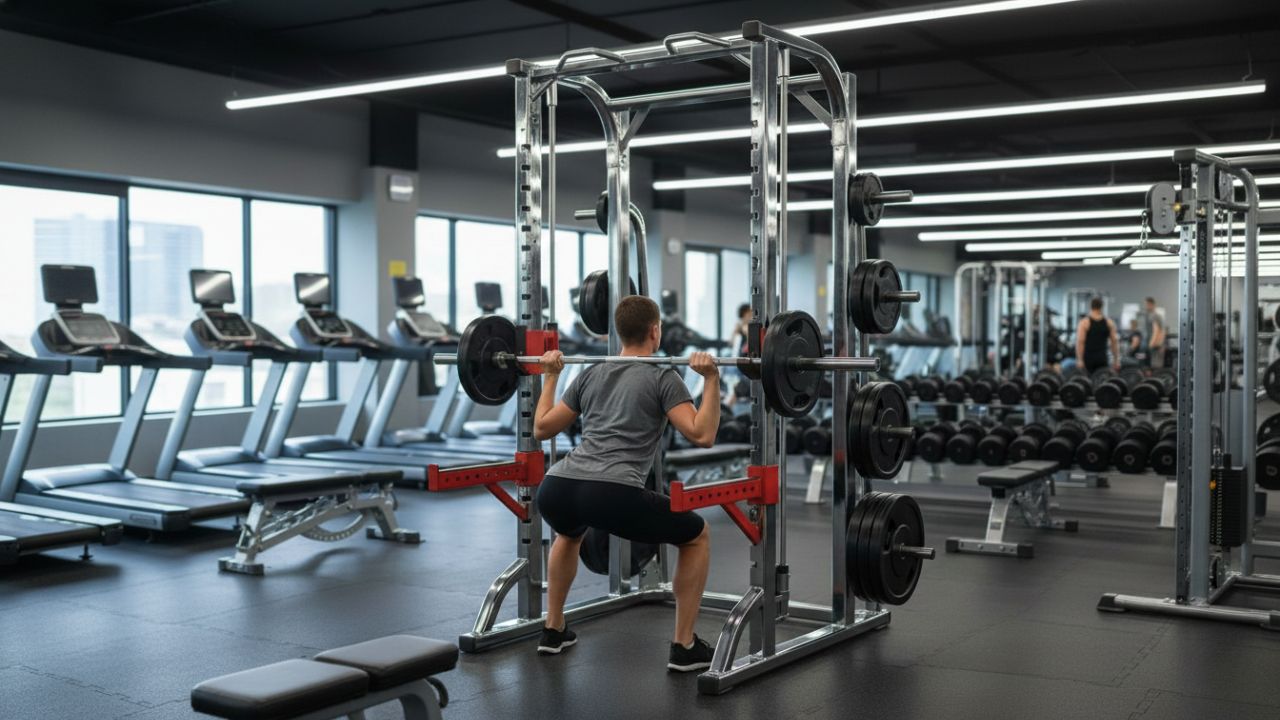
Smith Machine Exercises: Safe and Effective Moves

The Smith machine often sits in the corner of the gym, overlooked by free weight enthusiasts yet quietly serving as one of the most versatile pieces of equipment available. For anyone looking to build strength, improve muscle definition, or simply work out with added safety, this guided barbell system offers unique advantages that deserve serious consideration.
Unlike traditional barbells that move freely in all directions, the Smith machine features a barbell fixed within steel rails, allowing only vertical or near-vertical movement. This design creates a controlled environment that helps fitness enthusiasts of all levels perform exercises with greater confidence and precision.

60-Day Money-Back Guarantee
Cancel anytime, no commitments

60-Day Money-Back Guarantee
Cancel anytime, no commitments
60-Day Money-Back Guarantee
Cancel anytime, no commitments
Understanding the Smith Machine Advantage
The Smith machine’s guided bar path provides several distinct benefits that make it particularly valuable for certain training situations. The fixed movement pattern allows users to focus entirely on the muscles being worked without worrying about balance or stabilization. This can be especially helpful when learning new exercises, pushing for personal records, or training alone without a spotter.
The machine’s built-in safety stops represent another significant advantage. These adjustable hooks catch the bar at predetermined heights, preventing it from dropping too low during exercises. This feature enables solo training sessions with heavy weights while minimizing injury risk, something that’s difficult to achieve with free weights.
For those recovering from injuries or dealing with mobility limitations, the Smith machine offers a way to maintain strength training without placing excessive stress on stabilizer muscles or requiring perfect form. The controlled movement pattern can help isolate specific muscle groups while protecting vulnerable joints.
Essential Lower Body Smith Machine Exercises
Smith Machine Squats
Squats on the Smith machine allow for experimentation with foot placement and body positioning in ways that aren’t possible with free weights. Users can position their feet slightly forward of the bar, creating a movement pattern that emphasizes the quadriceps while reducing stress on the lower back. This forward foot placement would cause someone to fall backward with a regular barbell, but the Smith machine’s guided rails make it perfectly safe.
To perform Smith machine squats effectively:
- Position the bar across the upper traps or rear delts, depending on preferred squat style
- Place feet shoulder-width apart or slightly wider
- Unhook the bar and lower the body by bending at the knees and hips
- Descend until thighs reach parallel or slightly below
- Drive through the heels to return to starting position
- Re-rack the bar by rotating the wrists to engage the safety hooks
The ability to adjust foot placement makes Smith machine squats particularly valuable for targeting different areas of the legs. A wider stance with toes pointed outward shifts emphasis to the inner thighs and glutes, while a narrower stance increases quadriceps activation.
Bulgarian Split Squats
This single-leg exercise becomes more manageable on the Smith machine due to the fixed bar path, which eliminates the balance challenge that makes free weight versions so difficult. By removing the stability component, users can focus entirely on strengthening each leg individually and identifying any strength imbalances.
The setup involves positioning one foot forward under the bar and placing the rear foot on a bench behind. The Smith machine’s vertical path ensures the movement stays controlled throughout, allowing for heavier loads than most people can handle with dumbbells.
Calf Raises
The Smith machine excels for calf training because it allows users to load substantial weight safely while maintaining perfect balance. Standing calf raises can be performed with toes on a raised platform, enabling a full range of motion that deeply stretches and contracts the calf muscles.
Seated calf raises can also be adapted for the Smith machine by positioning a bench underneath and placing the bar across the thighs. This variation targets the soleus muscle, which lies beneath the larger gastrocnemius and contributes to overall calf development.
Upper Body Smith Machine Exercises
Bench Press Variations
The Smith machine bench press offers several advantages for chest development. The fixed bar path allows users to train to failure safely without requiring a spotter, making it ideal for home gyms or times when training partners aren’t available. The machine also enables experimentation with grip width and bar placement to target different areas of the chest.
Standard flat bench press develops overall chest mass, while incline bench press emphasizes the upper chest and front deltoids. Decline bench press, though less common, targets the lower chest fibers and can create impressive definition in this often-underdeveloped area.
Key points for Smith machine bench pressing:
- Position the bench so the bar descends to the appropriate chest location
- Keep feet flat on the floor for stability
- Lower the bar with control until it touches the chest
- Press upward forcefully while maintaining contact between back and bench
- Use the safety stops set just above chest height for solo training
Overhead Press
Shoulder pressing on the Smith machine removes the balance requirement of free weight overhead presses, allowing users to focus purely on pushing heavy weight. This can be particularly beneficial for building deltoid strength and size, especially when training alone.
Both seated and standing variations work well on the Smith machine. Seated pressing provides additional back support and stability, while standing overhead press engages the core more substantially and allows for a more natural pressing groove.
Inverted Rows
This underrated back exercise becomes much easier to set up with a Smith machine. By setting the bar at an appropriate height and hanging beneath it, users can perform bodyweight rows that build back thickness and improve pulling strength. The bar height can be adjusted to make the exercise easier or more challenging, with lower bar positions increasing difficulty.
Inverted rows serve as an excellent complement to bench pressing, helping maintain balanced upper body development and shoulder health. They’re also gentler on the lower back than bent-over rows since the body remains supported throughout the movement.
Core and Accessory Movements
Smith Machine Lunges
Forward lunges on the Smith machine provide a stable environment for developing single-leg strength and balance. The guided bar path ensures the movement stays controlled even when working with challenging loads, making it easier to focus on proper form and muscle engagement.
The Smith machine also enables reverse lunges, which place less stress on the knees while still effectively targeting the quadriceps, hamstrings, and glutes. The fixed bar path makes it simpler to step backward confidently without worrying about balance.
Hip Thrusts
For glute development, Smith machine hip thrusts have become increasingly popular as awareness of their effectiveness has grown. The machine’s fixed bar path makes it easier to position the bar correctly across the hips and maintain consistent form throughout the movement.
To perform Smith machine hip thrusts:
- Position a bench perpendicular to the machine
- Sit on the ground with upper back against the bench
- Roll the bar over the legs to the hip crease
- Use a bar pad for comfort
- Drive through the heels to lift the hips until the body forms a straight line
- Squeeze the glutes at the top before lowering with control
Shrugs
Trapezius development benefits greatly from the Smith machine’s vertical bar path. Heavy shrugs can be performed without the bar drifting forward or the body compensating with excessive momentum. The controlled movement ensures the traps do all the work, maximizing muscle engagement.
Both front and behind-the-back shrugs work well on the Smith machine, with each variation slightly different muscle activation patterns. Behind-the-back shrugs tend to emphasize the middle and lower traps more effectively.
Creating an Effective Smith Machine Workout
A well-designed Smith machine workout can serve as a complete training session or supplement free weight exercises. The key lies in selecting movements that complement each other and align with specific fitness goals.
Sample Full Body Workout
| Exercise | Sets | Reps | Rest Period |
|---|---|---|---|
| Smith Machine Squats | 4 | 8-12 | 90 seconds |
| Smith Machine Bench Press | 4 | 8-12 | 90 seconds |
| Smith Machine Rows | 3 | 10-15 | 60 seconds |
| Smith Machine Overhead Press | 3 | 8-12 | 90 seconds |
| Smith Machine Hip Thrusts | 3 | 12-15 | 60 seconds |
| Smith Machine Calf Raises | 3 | 15-20 | 45 seconds |
This workout targets all major muscle groups while taking advantage of the Smith machine’s safety features and fixed bar path. The moderate rep ranges build both strength and muscle size, making it suitable for intermediate lifters looking to progress steadily.
Progressive Overload Strategies
Like any resistance training, Smith machine exercises require progressive overload to continue producing results. Several methods can help ensure continued adaptation:
- Adding weight: The most straightforward approach involves gradually increasing the load on the bar as exercises become easier
- Increasing volume: Adding sets or reps challenges muscles to do more total work
- Tempo manipulation: Slowing down the eccentric (lowering) phase increases time under tension
- Reducing rest periods: Shorter breaks between sets increase workout density and cardiovascular demand
- Pause reps: Holding positions at challenging points in the range of motion adds difficulty without additional weight
Common Mistakes to Avoid
While the Smith machine offers numerous benefits, certain errors can limit its effectiveness or increase injury risk. Being aware of these pitfalls helps users maximize results while staying safe.
Over-Relying on the Machine
The Smith machine works best as part of a comprehensive training program rather than the sole source of resistance exercise. Free weights develop stabilizer muscles and functional strength that the Smith machine cannot fully replicate. A balanced approach incorporates both guided and free-moving exercises for optimal development.
Neglecting Proper Form
The Smith machine’s stability sometimes creates a false sense of security that leads to compromised technique. Poor form under load still causes injuries, even with guided equipment. Users should maintain the same attention to posture, alignment, and controlled movement that they would with any other exercise.
Ignoring the Safety Features
The Smith machine’s safety stops exist for a reason, yet many users fail to set them appropriately. Before each exercise, the stops should be positioned at a height that prevents the bar from pinning the user or dropping too far during the movement. This simple step dramatically reduces injury risk.
Using Excessive Weight Too Soon
The Smith machine’s guided path sometimes allows users to lift more weight than they could with free weights, but this doesn’t mean they should immediately max out. Muscles, tendons, and ligaments need time to adapt to increased loads. Progressive increases produce better long-term results than aggressive jumps that risk injury.
Comparing Smith Machine to Free Weights
The debate between Smith machine and free weight training continues in fitness communities, but the reality is less binary than many discussions suggest. Each approach offers distinct advantages that serve different purposes within a complete training program.
Free weights excel at developing functional strength, improving coordination, and engaging stabilizer muscles throughout compound movements. They more closely mimic real-world movement patterns and build the type of strength that transfers to daily activities and sports.
The Smith machine shines when isolation is desired, safety is paramount, or specific muscle groups need targeted development. It allows for training to failure without a spotter, enables unique exercise variations impossible with free weights, and provides a controlled environment for learning movement patterns or rehabilitating injuries.
Rather than choosing between the two, most people benefit from incorporating both into their training. Free weights might form the foundation of strength development, while the Smith machine serves specific purposes like finishing exercises, single-limb work, or high-intensity techniques.
Who Benefits Most from Smith Machine Training
Certain individuals and situations particularly suit Smith machine exercises. Beginners learning basic movement patterns appreciate the guided bar path that helps them understand proper positioning without the added challenge of balance. The machine provides a stepping stone between machines and free weights, building confidence and foundational strength.
Experienced lifters use the Smith machine strategically for specific purposes. Training to failure safely, performing drop sets, or isolating particular muscles becomes simpler with the fixed bar path. The machine also enables training alone without safety concerns that would require a spotter with free weights.
Those recovering from injuries often find the Smith machine invaluable for maintaining strength while protecting vulnerable areas. The controlled movement and adjustable safety stops allow for progressive loading without the unpredictability of free weights.
Home gym owners benefit from the Smith machine’s versatility and safety features. A quality Smith machine can replace multiple pieces of equipment while enabling solo training without the risks associated with heavy free weight exercises performed alone.

No Needles or Prescriptions
Free delivery on orders over $100

No Needles or Prescriptions
Free delivery on orders over $100

No Needles or Prescriptions
Free delivery on orders over $100
Final Thoughts on Smith Machine Training
The Smith machine deserves a place in any well-equipped gym and can play a valuable role in diverse training programs. Its unique characteristics make certain exercises safer, more accessible, or simply different from their free weight counterparts. Rather than viewing it as inferior to free weights or superior to other machines, fitness enthusiasts benefit from recognizing it as another tool with specific applications.
Success with Smith machine training comes from understanding its strengths and limitations, using proper form despite the guided bar path, and integrating it intelligently into a broader fitness approach. Whether someone is building foundational strength, rehabilitating an injury, training alone, or simply looking to add variety to their workouts, the Smith machine offers safe and effective options worth exploring.
The exercises outlined here represent just a starting point. As users become comfortable with basic movements, they can experiment with advanced variations, unilateral exercises, and creative combinations that leverage the Smith machine’s unique design. With consistent effort and progressive overload, this often-underappreciated piece of equipment can contribute significantly to achieving fitness goals.
Discover more from Maximize Workouts
Subscribe to get the latest posts sent to your email.